
7 Ways to Make Meetings More Productive and Worth Attending

Three minutes before a meeting, you find yourself frantically trying to recall who’s in the room, what was discussed last, and why it matters. You dig through your inbox for that elusive email thread, piece together a conversation from weeks ago, and question whether you even need to be on the call. Keeping track of these details is key to building strong personal connections. But by the time the meeting begins, you’re already playing catch-up.
It’s a familiar frustration and one that’s becoming all too common. Today, the average professional spends roughly a third to half of their workweek in meetings, many of which are widely seen as unproductive.
The good news is that meeting fatigue is almost never about the meetings themselves, but about everything surrounding them. The preparation that doesn't happen. The purpose that was never defined. The action items that were vaguely agreed upon and promptly forgotten.
Fix those things, and meetings stop being an obligation and start being one of the most valuable uses of your working day. Here are seven practical ways to do that.
1. Prepare Before You Walk In the Door
The biggest drain on meeting quality is the work that doesn’t happen before the meeting. Walking in cold forces everyone to spend the first ten or fifteen minutes reconstructing context that could have been reviewed in advance: who's in the room, where the project stands, what was committed to last time, and what still needs to be resolved.
That's time nobody can afford to waste, and it sets a poor tone for the conversation that follows.
Make pre-meeting prep a non-negotiable habit. Even five focused minutes before an important call can transform the quality of what follows. You arrive grounded rather than guessing, which makes you sharper, more attentive, and more useful to everyone else in the room.
For professionals managing large networks and heavy meeting schedules, this kind of preparation can feel logistically difficult. Context is scattered across inboxes, calendars, documents, and memory, reassembling it manually before every meeting is time-consuming. Some professionals use dedicated tools to solve this.
Dex, for example, is a personal relationship manager that automatically sends a brief summary about ten minutes before each qualifying meeting, pulling together recent emails, past meeting history, and notes you've previously captured about each attendee. It's a good example of how the right system can make consistent preparation effortless rather than effortful.
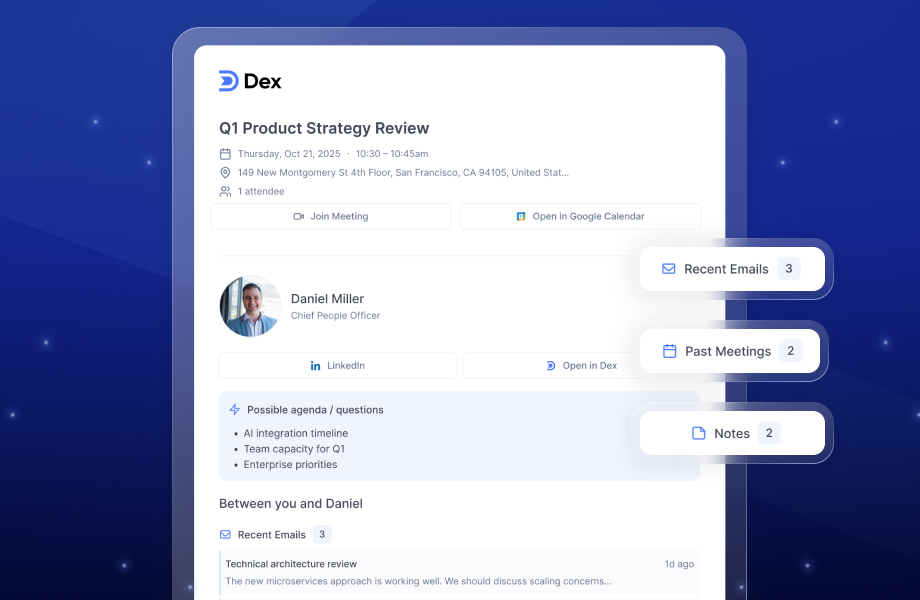
However you get there, the goal is the same. It's to arrive informed, not improvising.
2. Define the Purpose Before Sending the Invite
A meeting without a clear purpose is just a calendar block with people attached to it. And yet, an enormous number of meetings are scheduled without anyone asking the most basic question: what exactly needs to happen here, and why does it require a meeting to happen?
Before sending a meeting invite, clearly define the purpose in a single, specific sentence. Not vague phrases like “sync on the project” or “Q1 update,” but something concrete, like “finalize the feature set for the March product release,” “decide on the pricing tiers for the new plan,” or “review beta user feedback and agree on follow-up actions.”
If you can’t state the purpose clearly, the meeting probably isn’t ready yet. It might be better handled via a shared doc with comments, a short async update in Slack, or a quick 10-minute call between a few key team members before turning it into a full meeting.
When you schedule a meeting, put the clear purpose in the invite. It gives attendees a reason to come prepared, sets a benchmark for the discussion, and lets you steer the conversation or end early if goals are met. Clarity of purpose is the foundation of every effective meeting.
3. Invite Only the People Who Need to Be There
In organizations, it’s common to invite people to meetings out of caution, courtesy, or politics. You loop in the senior leader to show respect, include the whole team so no one feels left out, or add a neighboring department “just in case.” The result? Eight people in a meeting where half are mostly waiting for their part, and the rest hold back, unsure if it’s safe to speak freely.
Every additional person in a meeting increases its complexity, slows its pace, and dilutes the quality of the conversation. Research on group dynamics consistently shows that decision-making quality tends to peak in small groups and decline as size increases. The ideal meeting for most purposes involves between two and five people, just enough for meaningful dialogue, small enough for everyone to participate.
Be deliberate about your attendee list. Ask yourself, for each person: do they need to contribute to this conversation, or do they just need to know the outcome? The latter group is almost always better served by a clear, well-written follow-up summary than by an hour of their time.
TIP: Give people the information they need without requiring their presence, and reserve the meeting itself for the people who genuinely need to be in the room.
4. Set an Agenda You Will Actually Follow
At its simplest, an agenda does three things: it tells people what will be discussed, it signals how time will be allocated, and it gives the meeting a natural structure that prevents aimless conversation.
A good agenda doesn't need to be long or elaborate. Even a three-item list with rough time allocations: five minutes for updates, fifteen minutes to review the proposal, and ten minutes to agree on next steps. This is far more useful than arriving with no structure at all.
Send the agenda with the invite, not five minutes before the meeting starts. This gives people the chance to prepare their contributions, flag anything missing, and arrive with relevant information in hand. It shows that you are on top of the meeting, which in turn also makes you a good people connector.
During the meeting, keep it visible and reference it explicitly. If the conversation goes off-track, use the agenda to redirect:
"That's worth discussing, but let's park it for now and come back to it. We still need to cover X and Y before we run out of time."
TIP: A particularly useful habit is to include a final agenda item simply called "Next steps." Making this an explicit part of the structure, rather than something that happens if there's time left over. The agenda then becomes both a guide for the conversation and a guarantee that it ends with something concrete.
5. Start and End on Time
This one sounds obvious, but the gap between knowing it and actually doing it is wider than most organizations care to admit.
Meetings that start late send a clear message: the time of people who arrive punctually is worth less than the convenience of people who don't. Over time, late starts train an entire team to stop showing up on time, because experience has taught them it doesn't matter.
Start at the scheduled time, regardless of who's missing. Latecomers can be caught up on what they missed. This approach respects the people who made the effort to be punctual and creates a natural incentive for everyone to do the same going forward.
The same logic applies at the other end. Meetings that run over erode trust, throw off the rest of the day, and leave people feeling like their schedule isn't their own. Ending on time is one of the simplest ways to signal that you value the people you're meeting with. It also gives everyone a brief transition moment before their next obligation, which turns out to matter more than most people expect. Back-to-back meetings with no breathing room are cognitively exhausting in a way that accumulates across a working day and steadily degrades the quality of engagement.
If you consistently find that meetings run over, the problem is usually one of two things: the scope was too large for the time allocated, or the agenda wasn't being used actively to manage the pace. Both are fixable with a bit of intention.
6. Assign Clear Action Items Before You Leave
This is the step that most meetings skip, and it's the reason so many of them feel pointless in retrospect.
The conversation happens. There's a general sense that things have been discussed and a direction has been agreed, then everyone leaves, gets absorbed by the rest of their day, and a week later, when someone checks on progress, nobody is quite sure who was supposed to do what.
The fix is simple and takes less than two minutes at the end of every meeting: before closing, explicitly confirm the action items. What needs to happen next? Who owns each item specifically? And when does it need to be done?
Write these down during the meeting, not afterward. Send a brief summary within an hour of the meeting ending, this shows good leadership, and keeping things on track while the conversation is still fresh for everyone.
Tools like Dex make this even easier. Dex lets you:
- Take notes on conversations and action items across contacts and interactions.

- Set reminders tied to people or follow‑ups, so responsibilities actually get done on schedule.
- You can use Dex Copilot to surface any notes or details you’ve recorded in advance, so you can keep track of what was assigned to whom.
This creates accountability, provides a reference point for follow-up, and closes the loop between the discussion and the work it was meant to generate. It also changes how people experience meetings over time. When attendees know that every meeting ends with clear, documented commitments, they arrive more prepared, contribute more purposefully, and leave with a clearer sense of what success looks like. The discipline of closing with action items is one of the highest-leverage habits an individual or a team can build.
7. Build a System for Relationship Continuity
The best meetings feel like meaningful moments in an ongoing conversation between people who have history with each other, who trust each other, and who remember the details of what's been shared before.
When a manager remembers a challenge a team member mentioned six weeks ago and asks how it was resolved, that moment of attentiveness matters more than almost anything else they could do in a one-to-one. When a client references something said in a previous meeting, it builds a quality of trust that is genuinely difficult to earn any other way.
That kind of relational continuity doesn't happen by accident. It requires a deliberate system: consistent note-taking after meaningful conversations, a reliable way to store and retrieve that context, and the habit of reviewing it before each meeting.
Looking at the Bigger Picture with Dex: Your Personal CRM for Smarter Meetings
The organizations and individuals who get the most from their meetings are ones who treat every meeting as worth doing well: with a clear purpose, the right people, genuine preparation, and a commitment to turning conversations into action.
With a personal CRM like Dex, instead of relying on memory or scattered notes, you can log brief observations after each interaction and have that history surfaced automatically before future meetings. You don’t need comprehensive notes, just a few sentences capturing what was discussed, what mattered to the other person, and what was agreed. Over time, these accumulated insights become a living record of your professional relationships, making every subsequent meeting richer and more meaningful.
Even without a dedicated tool, the principle holds: find a system, use it consistently, and make it a habit. That’s a standard worth holding yourself to, and once you do, it raises the bar for everyone around you.
Try Dex free for 7 days and start turning every meeting into clear, actionable outcomes.
Frequently Asked Questions About Personal CRMs
What Is a Personal CRM?
A personal CRM is a tool designed to help you manage both personal and professional connections. It allows you to organize your network with notes, reminders, and smart management features. Many modern personal CRMs now include an AI assistant for personal relationships, which can help you prioritize contacts, suggest follow-ups, and highlight key details from your past interactions. These platforms often combine the functionality of an address book, calendar, map, and database, making it easier to use AI for networking and to nurture meaningful connections over time.
What Is a Personal CRM Used For?
A personal CRM helps you keep all contact information in one central place, giving you a complete view of each relationship. It can analyze this information to suggest the best times to reach out, recommend personalized messages, or identify connections that may help you achieve your goals. Integrations with email, calendars, and social media make managing your interactions more efficient. Setting reminders for birthdays, anniversaries, and follow-ups ensures you never miss important dates, helping you stay proactive and show genuine care in your relationships.
Is a Personal CRM Easy to Learn and Use?
The learning curve depends on the platform, but most personal CRMs are designed to be intuitive and user-friendly. Modern CRMs with AI assistants make adoption even smoother by offering smart suggestions, automated reminders, and helpful prompts. With the right guidance and resources, most users can get comfortable quickly, leveraging AI to manage and grow their relationships without a steep learning curve.